
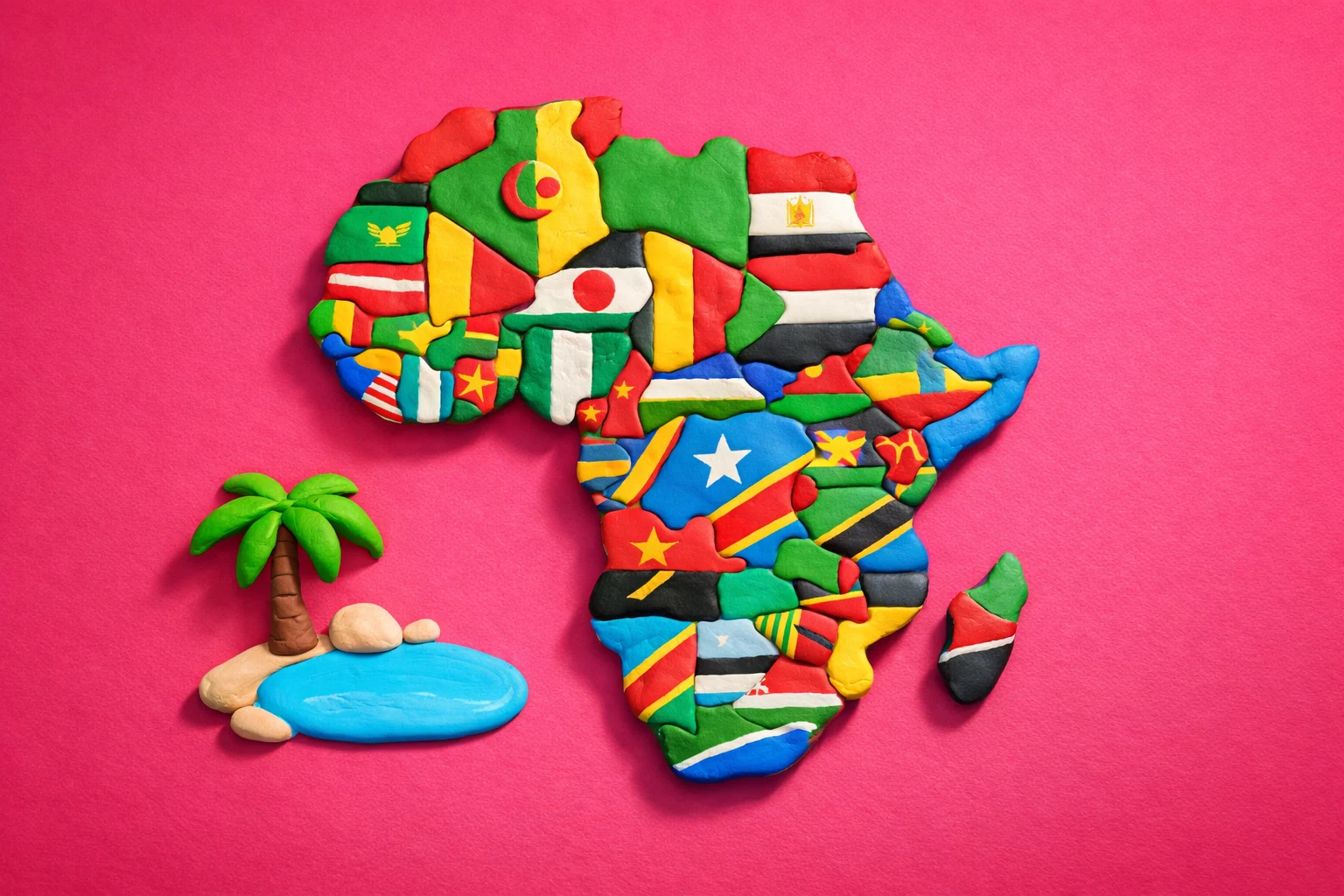
African Countries Quiz Name All 54
True / False
True / False
True / False
True / False
True / False
True / False
True / False
True / False
True / False
True / False
True / False
True / False
Frequent Pitfalls When Naming All 54 African Countries
Naming every African state is harder than it looks because the hardest errors come from name similarity, recent renamings, and status confusion about what counts as a sovereign state.
1) Mixing up “near-twins”
- Republic of the Congo vs Democratic Republic of the Congo. Avoid guessing. Pair each with its capital as a cue: Brazzaville vs Kinshasa.
- Niger vs Nigeria. Treat them as a fixed pair and learn one extra fact for each, like Niger is landlocked, Nigeria is coastal.
- Guinea, Guinea-Bissau, and Equatorial Guinea. Memorize the trio together so you do not “use up” Guinea twice.
2) Using older country names without noticing
- Eswatini is often recalled as Swaziland.
- Cabo Verde is often recalled as Cape Verde.
- Côte d’Ivoire is often written as Ivory Coast in English contexts.
Fix this by keeping a short “renamed countries” list and reviewing it before you retake the quiz.
3) Counting territories or disputed entities as “countries”
Lists vary. A common standard for “all African countries” is the 54 UN member states in Africa. That excludes non-sovereign territories like Réunion, Mayotte, the Canary Islands, and Ceuta and Melilla. It also avoids disputes like Western Sahara, which appears in some political and organizational lists.
4) Losing points on spelling, punctuation, and diacritics
- Do not drop the apostrophe in Côte d’Ivoire or the accents in São Tomé and Príncipe when your quiz mode requires exact spelling.
- Watch for short, easily mistyped names: Chad, Mali, Togo, Benin.
5) Forgetting the “small and offshore” states
Misses cluster around island and micro states. Keep a final sweep checklist for Cabo Verde, Comoros, Mauritius, Seychelles, São Tomé and Príncipe, plus The Gambia (often omitted because it is geographically narrow).
Five Ways to Keep Africa’s 54 Sovereign States Straight
- Anchor your answers to one naming standard
Country lists differ because organizations use different short forms and membership rules. Use one reference list for practice, then learn the common variants you will still see in quizzes, like Cabo Verde versus Cape Verde and Côte d’Ivoire versus Ivory Coast.
Action:Pick one authoritative list and copy the 54 names into a study sheet. Add a second column for the two or three alternate English forms you see most often. - Memorize the high-confusion clusters as groups
Most misses come from a few repeated traps. Treat Congo and DR Congo as a set. Treat the three Guineas as a set. Treat Sudan and South Sudan as a set. Learning them together prevents substitution errors under time pressure.
Action:Make three flashcard stacks labeled Congo pair, Guinea trio, and Sudan pair. Drill them until you can say each member without hesitation. - Separate “sovereign states” from territories and disputed entities
Africa includes many politically linked territories and a few disputed cases. The “all 54” convention usually means the 54 UN member states located in Africa, which excludes overseas departments and most partially recognized entities.
Action:Write a two-line rule for yourself: “Count UN member states in Africa. Do not count overseas territories.” Then list three examples you will not count, like Réunion, Mayotte, and the Canary Islands. - Use subregions plus an island checklist
Geographic organization reduces random recall. Split Africa into five UN statistical subregions, then do a final island pass. This catches common omissions like Seychelles and São Tomé and Príncipe, which do not border other states.
Action:Practice by writing countries in five blocks: North, West, Middle, East, Southern. After each run, append a separate “islands” line and verify it contains every island state you expect. - Track modern renamings and post-independence state formation
Modern political history affects what name is accepted and what counts as current. Eswatini’s renaming and South Sudan’s 2011 independence are common knowledge checks because they test up-to-date state lists, not just colonial-era maps.
Action:Create a “modern changes” mini-timeline with dates for major changes you need for quizzes, including South Sudan (2011) and Eswatini’s name change (2018).
Reference Lists That Match Common “All 54 African Countries” Conventions
- UN Statistics Division (M49) country and area codes: Official UN short-form names and regional groupings, useful for consistent spellings and subregion practice.
- UNTERM Country Names Download: Downloadable country-name tables from the UN terminology system, helpful for checking preferred English forms and multilingual equivalents.
- AU-UN Member States: African Union and UN membership context, including the common “54 are UN members” framing that often underlies quiz lists.
- U.S. Department of State, Office of the Historian, All Countries: A diplomatic-relations reference that helps confirm recognized country names used in U.S. foreign policy writing.
- U.S. Census Bureau International Database, Countries and Areas: A structured list with codes and revision notes, useful for spotting alternate spellings and legacy names in datasets.
Africa Country-Name Quiz FAQ: Borders, Names, and Recognition
Why do some sources say Africa has 55 countries instead of 54?
Many “55” counts come from African Union membership, which includes 55 member states. The AU-UN list notes that 54 of those are UN members, which aligns with the common quiz convention of “54 African countries” as the UN member states in Africa. Disputed cases, especially Western Sahara, are the usual reason people see different totals.
Which island countries are included in the 54, and which are most often missed?
The sovereign island states you are expected to know are Cabo Verde, Comoros, Madagascar, Mauritius, Seychelles, and São Tomé and Príncipe. Misses happen because they do not sit inside big border clusters, so they need a separate checklist pass.
Do overseas territories in or near Africa count as countries?
No, not under the “all 54 sovereign states” convention. Places like Réunion and Mayotte are French departments, and the Canary Islands are part of Spain. They are geographically connected to Africa but they are not sovereign states.
How can I reliably distinguish the Republic of the Congo from the Democratic Republic of the Congo?
Use a two-cue rule. First, match capitals: Brazzaville is the Republic of the Congo, and Kinshasa is the Democratic Republic of the Congo. Second, match the common shorthand used in writing: “Congo-Brazzaville” versus “Congo-Kinshasa” or “DR Congo.”
Are older names like Swaziland or Cape Verde considered wrong?
For historical knowledge, you should recognize them as older or alternate English forms. For modern country-name lists, the current short forms are Eswatini and Cabo Verde. If you are studying for strict-spelling modes, learn the current forms first, then keep the older names as quick cross-references.
What about Somaliland or Western Sahara?
Somaliland is a self-declared state that is not widely recognized as a sovereign UN member state, so it is not part of the standard 54 list. Western Sahara is disputed and appears in some organizational contexts, including African Union membership discussions. Most “54 countries” quizzes avoid the dispute by using the UN member-state count for Africa.
Want more quizzes like this? Explore the full professional training quizzes on QuizWiz.