
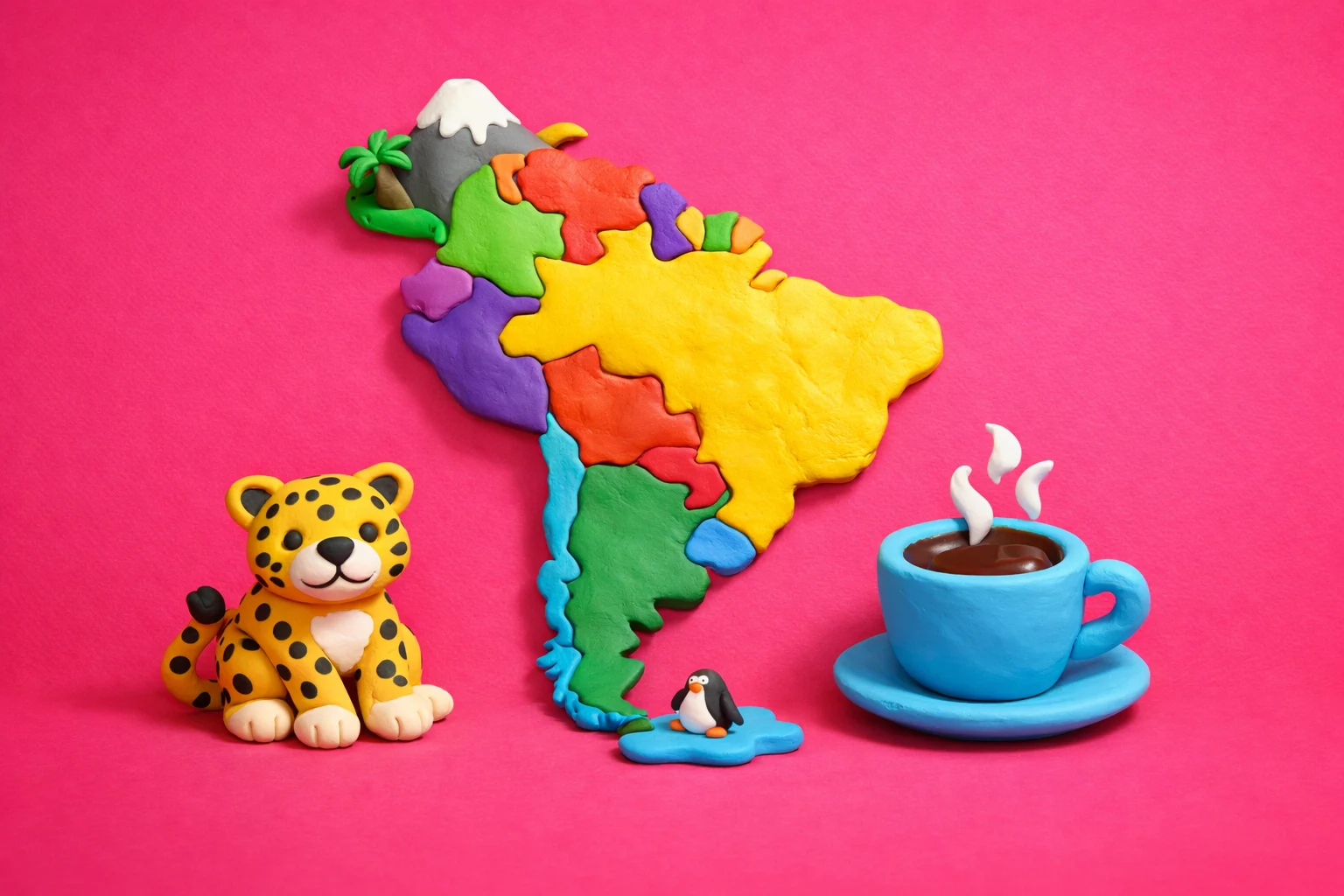
South American Countries Quiz
True / False
True / False
True / False
True / False
Frequent confusions in naming and counting South American countries
Mixing continents, regions, and cultural labels
A common error is treating “Latin America” or “the Americas” as if they match the continent of South America. Panama is often pulled in because of the Darién Gap and its ties to Gran Colombia, but it is part of Central America. Caribbean states are also mistakenly included because they are Spanish-speaking or part of South American organizations.
- Avoid it: anchor your list to the South American continent first, then add cultural regions as a second layer.
Counting territories as sovereign countries
French Guiana is regularly misidentified as a country, even though it is an overseas department of France. The Falkland Islands (Islas Malvinas) and South Georgia and the South Sandwich Islands also trigger errors because they appear on political maps and in sovereignty disputes.
- Avoid it: separate sovereign states from dependencies and overseas territories before you start memorizing.
Confusing similar country names on the Atlantic side
The “Guianas” are a high-frequency trap: Guyana, Suriname, and French Guiana are adjacent but differ in sovereignty and colonial language legacies (English, Dutch, and French). Many learners also swap Uruguay and Paraguay because the names rhyme.
- Avoid it: learn each name with one fixed identifier, for example “Guyana, Georgetown, English” and “Suriname, Paramaribo, Dutch.”
Importing historical polities into a modern country list
Answers sometimes include Gran Colombia, the Viceroyalty of Peru, or other colonial units. Those entities matter for history questions, but they are not contemporary countries.
- Avoid it: treat colonial viceroyalties and 19th-century federations as context for borders, not as options for a present-day country count.
Five high-yield patterns for identifying South America’s countries
- Lock in the sovereign-country set before anything else
For modern political geography, South America has 12 sovereign countries: Argentina, Bolivia, Brazil, Chile, Colombia, Ecuador, Guyana, Paraguay, Peru, Suriname, Uruguay, and Venezuela. Treat French Guiana and the Falkland Islands as territories that appear on maps but do not add to the sovereign count.
Action:Write the 12-country list from memory, then check it against a map. - Use the Andes as your mental backbone
The Andes create a reliable north to south spine on the Pacific side: Colombia, Ecuador, Peru, Bolivia, and Chile. This pattern reduces random recall, because you can rebuild the list by following a single mountain corridor and then filling in the Atlantic side separately.
Action:Trace the Andes chain on a blank map and label the five countries in order. - Colonial language legacies explain many name clues
Portuguese points strongly to Brazil. Spanish dominates most of the rest. The northeastern “Guianas” preserve different colonial histories, with Guyana linked to English, Suriname to Dutch, and French Guiana to French administration. These legacies often show up in official documents, demonyms, and place names.
Action:Match each Guianas area to its colonial language, then add one capital for each. - Independence-era history is the bridge between old maps and new borders
Many modern borders reflect the breakup of Spanish imperial administration and the independence wars of the early 1800s. Recognizing terms like “viceroyalty” or “Gran Colombia” helps you avoid treating those historical units as present countries, while still using them to place Colombia, Venezuela, Ecuador, and Panama in context.
Action:Summarize in two lines how Gran Colombia relates to Colombia, Venezuela, and Ecuador. - Separate sovereignty disputes from country identification
Some places are politically contested or administratively linked to non South American powers, but quizzes usually follow widely used statistical and diplomatic definitions of “country.” That means you should distinguish between a sovereign state (for example Argentina) and a territory or claim (for example the Falklands or Antarctic sectors).
Action:Make a two-column list: “sovereign states” vs “territories and claims shown on maps.”
Primary reference hubs for country lists, codes, and continental groupings
- UN Statistics Division, M49 methodology: Official UN geographic groupings and country or area codes, useful for verifying what is counted as “South America” in many datasets.
- Organization of American States, Member States: Diplomatic membership list with standardized state names across the Americas, helpful for confirming sovereign state naming conventions.
- National Geographic Education, South America: Human Geography: Accessible overview with maps and regional context that reinforces the continent’s country set and key physical features.
- Library of Congress, MARC Code List for Countries (regional sequence): Standardized country and area coding used in libraries, useful for spotting territories versus sovereign states.
- World Bank Open Data, All Countries and Economies: Searchable country pages and downloadable indicators, helpful for practicing recognition of official country names and codes.
South American Countries Quiz FAQ: borders, names, and territories
Common point-of-confusion questions
How many sovereign countries are in South America, and which ones count?
Most modern references treat South America as having 12 sovereign countries: Argentina, Bolivia, Brazil, Chile, Colombia, Ecuador, Guyana, Paraguay, Peru, Suriname, Uruguay, and Venezuela. Lists get inflated when people add non-sovereign territories like French Guiana or the Falkland Islands. (education.nationalgeographic.org)
Is French Guiana a country?
No. French Guiana is an overseas department and region of France. It sits on the South American mainland, which is why it appears on maps of the continent, but it is not a sovereign state and it does not have separate UN membership.
Are Guyana and Suriname “really” part of South America?
Yes. They are on the northeastern coast of the South American continent and are routinely grouped with South America in geographic and statistical classifications. Confusion usually comes from their different colonial languages and their stronger historical ties to the Caribbean than to the Spanish-speaking Andes.
Does Panama belong in a South America country list?
Panama is normally classified as Central America (and therefore part of the North American continent in many geographic models). It is historically linked to northern South America, including periods when it was part of larger political units, but a present-day South America country list typically excludes it.
Do disputes like the Falkland Islands change the list of countries?
Disputes change how maps are labeled, but they usually do not change the count of sovereign countries used in quizzes. The Falkland Islands are a territory administered by the United Kingdom and claimed by Argentina. Treat them as a sovereignty issue, not as an extra country.
Do I need to use full official state names (for example “Bolivarian Republic of Venezuela”)?
In most geography and history contexts, the short form is acceptable (for example Venezuela, Bolivia). Full constitutional names matter in diplomacy and some datasets, so it helps to recognize them, but the core skill is matching the short name to the correct place on the continent.
Want more quizzes like this? Explore the full QuizWiz workplace quiz library.